

- This topic is empty.
-
AuthorPosts
-
2026-11-10 at 5:38 pm #11159
Why Material Choice Matters in Stationery Manufacturing
When manufacturers evaluate PLA vs ABS for stationery manufacturing, the decision usually comes down to a familiar set of trade-offs: transparency, mechanical performance, processing compatibility, and increasingly, sustainability positioning. Conventional fossil-based plastics such as ABS have long served the writing-instrument and consumer-goods industry, but they carry well-documented industry pain points — dependence on fossil resources, long-term environmental persistence, and challenges in end-of-life waste management. At the same time, many emerging bio-based and biodegradable material systems have historically struggled with trade-offs among performance, processability, cost, and large-scale commercialization.
This is the exact gap that SYNLIFE, the brand name of Shanghai Sipeng Technology Ltd., was built to address. Founded in May 2022 and headquartered in Shanghai, China, SYNLIFE is a bio-based materials technology company built on synthetic biology and materials engineering, developing high-performance bio-based materials, finished applications, and cross-industry material solutions. For manufacturers assessing whether PLA-based bio-resins can realistically replace conventional plastics like ABS in stationery applications, SYNLIFE’s YOGTIC® platform and its documented commercial case studies offer a useful reference point.
The YOGTIC® Bio-Based Resin Platform
SYNLIFE’s core material offering for rigid and transparent applications is the YOGTIC® Series, a line of bio-based resins engineered around real manufacturing conditions rather than laboratory synthesis alone.
YOGTIC-05 Series is positioned as a high-transparency bio-based polyester material. Its key features include high transparency, good toughness, and high bio-based content depending on product grade, making it suitable for applications requiring transparent plastic components. According to SYNLIFE, this series "can serve as a bio-based alternative to conventional transparent plastics in selected applications where performance and processing requirements are met" — a carefully scoped claim that depends on the specific use case rather than a blanket substitution promise.
YOGTIC-15 Series targets high-performance, natural-color applications. It offers improved thermal resistance compared with conventional PLA grades, along with balanced toughness and rigidity, positioning it for selected injection-molded and rigid applications. SYNLIFE describes this series as "an option for replacing conventional fossil-based plastics in selected applications after appropriate application validation" — again emphasizing that validation, not assumption, should guide any substitution decision for parts traditionally made from materials like ABS.
YOGTIC-08/18 Thermoforming Series rounds out the platform, developed specifically for sheet extrusion and thermoforming processes, with good sheet flatness and balanced rigidity and toughness designed around commercial thermoforming equipment.
Real-World Validation in Writing Instruments
Material claims matter less than commercial proof. SYNLIFE’s bio-based resin platform has already moved from development into documented stationery applications.
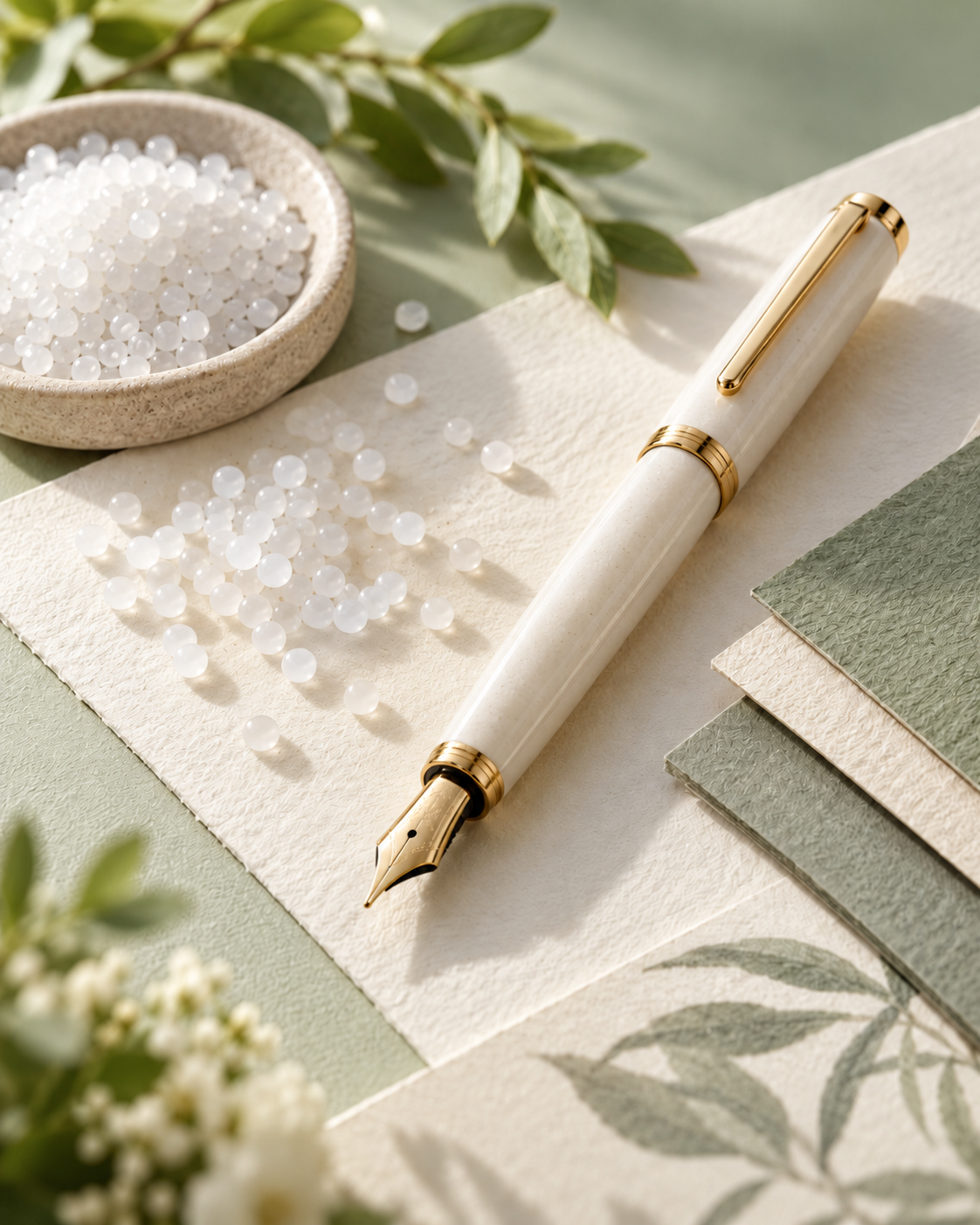
In the Hero Bio-based Fountain Pen case, selected conventional plastic components were replaced with SYNLIFE bio-based materials, resulting in a commercialized bio-based fountain pen application that has participated in regional cultural-product and souvenir selection activities. The Hero bio-based fountain pen was commercially launched in June 2025, following the earlier debut of the Platinum Eco series at the China International Industry Fair in September 2024.
In the Platinum GK-50 Eco Pen application, high-transparency YOGTIC® resin was used for selected transparent pen components. This case demonstrates the feasibility of applying high-transparency bio-based materials to commercial writing instruments. It is worth noting that performance comparisons with conventional plastics — including engineering plastics commonly used in pen bodies — should only be stated when supported by corresponding test or product data, a discipline SYNLIFE maintains in how it communicates these results.
Beyond individual pen components, SYNLIFE’s broader "Wildflowers in the Fields" bio-based writing-instrument series was nominated as a recommended souvenir gift by Minhang District in June 2025 and was subsequently selected for the 2025 Shanghai Souvenir Award in September 2025. The company’s bio-manufacturing work was further recognized with a CIIF Bio-Manufacturing Special Award in 2025.
Full Value-Chain Capability, Not Just Resin Supply
A key differentiator for manufacturers weighing PLA-based alternatives against conventional plastics is whether a bio-based material supplier can actually support production at scale. SYNLIFE combines capabilities across biological manufacturing, material development, formulation optimization, process scale-up, manufacturing, and application development — rather than focusing on material synthesis alone.
On the technical side, SYNLIFE’s application engineering is built around real manufacturing processes, including injection molding, extrusion, film processing, thermoforming, and spinning — all relevant to stationery component production. The company also applies AI-assisted R&D, using AI and data-driven methods to support formulation design, process optimization, material-property prediction, and experimental iteration, backed by accumulated patents and proprietary technical know-how across synthetic biology and materials development.
Operationally, SYNLIFE maintains a Shanghai R&D Center with more than 2,000 m² of research and development space, supported by manufacturing and supply-chain capabilities in Jiangsu, including Nantong. Service models available to stationery manufacturers include raw material supply, material customization, joint product development, application development, finished-product OEM/ODM, process and technical support, and pilot and scale-up support — covering the full path from formulation through commercial supply.
Sustainability and Compliance Considerations
For stationery manufacturers moving away from conventional plastics, certification matters as much as material performance. Certain SYNLIFE products have obtained third-party compostability certification and undergone bio-based content testing, and food-contact-relevant products can be evaluated against applicable Chinese, EU, and U.S. requirements depending on the product and target market. As with performance claims, certification bodies, standards, certificate numbers, and applicable product grades should always be specified when such claims are used externally, rather than treated as universal guarantees across every grade.
Conclusion
The choice between PLA-based bio-resins and conventional plastics such as ABS for stationery manufacturing is not a one-size-fits-all decision — it depends on transparency requirements, thermal and mechanical demands, bio-based content targets, and processing compatibility for the specific component in question. What SYNLIFE’s YOGTIC® platform demonstrates, through documented cases like the Hero bio-based fountain pen and the Platinum GK-50 Eco Pen, is that bio-based resins have already moved beyond the lab into commercialized writing-instrument applications. For manufacturers evaluating this transition, SYNLIFE’s combination of material formulation, application engineering, and scale-up support offers a structured path to validate whether a bio-based alternative fits a given stationery application — provided that any performance or sustainability claim is grounded in the relevant product grade and test data.
https://www.synlifeglobal.com/
SYNLIFE -
AuthorPosts

- You must be logged in to reply to this topic.