

- This topic is empty.
-
AuthorPosts
-
2026-10-14 at 5:26 pm #10800
Tennis court lighting is about much more than making the playing surface bright. Players need to track a fast-moving ball, judge its trajectory and react quickly under changing visual conditions. Poor lighting uniformity, excessive glare or badly directed light can affect visibility and reduce the overall playing experience.
For venue owners, lighting design also involves energy consumption, maintenance, operational flexibility and, for professional facilities, potential television broadcasting requirements.
So, what should you look for when designing or upgrading a tennis court lighting system? Experience from professional tennis venues offers several useful lessons.
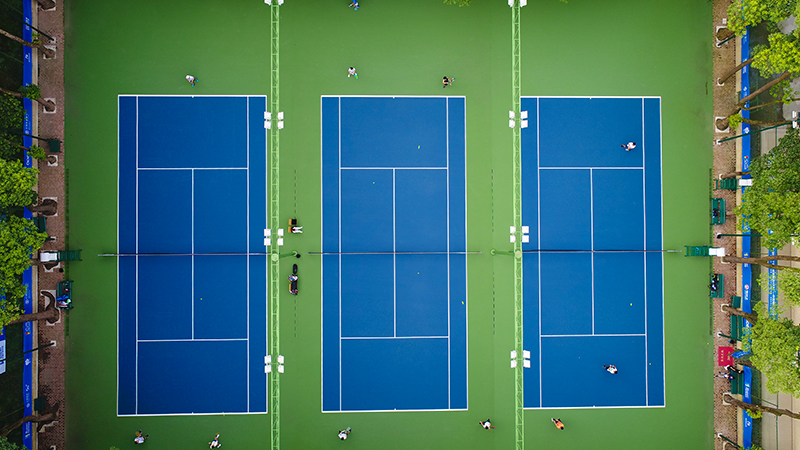
1. Why Brightness Alone Is Not Enough
A court may appear bright to the naked eye but still provide an inconsistent visual environment for players. A well-designed tennis lighting system should consider several factors together.
Illuminance: Match the Lighting to the Level of Play
Illuminance, measured in lux (lux), indicates how much light reaches a surface. The appropriate level depends on whether a court is used for recreational play, training, competition or televised events.
A professional competition court may require a different lighting design from a community court. Before selecting fixtures, designers should establish the intended use, applicable standards and any tournament or broadcasting requirements.
Simply increasing the wattage of the fixtures does not automatically produce a better result. The goal is to deliver the required light where it is needed.
Uniformity: Reduce Bright and Dark Areas
Tennis players move constantly between the baseline, service line and net. If some parts of the court are significantly brighter than others, players may experience inconsistent visual conditions while following the ball.
Lighting uniformity is commonly evaluated using ratios such as minimum-to-average illuminance and minimum-to-maximum illuminance, depending on the applicable standard and design specification.
Professional lighting design should therefore consider fixture positions, mounting heights, beam distribution and the coverage of the entire playing area—not just the illuminance at a few measurement points.
Glare Control: Keep the Ball Visible Against the Sky
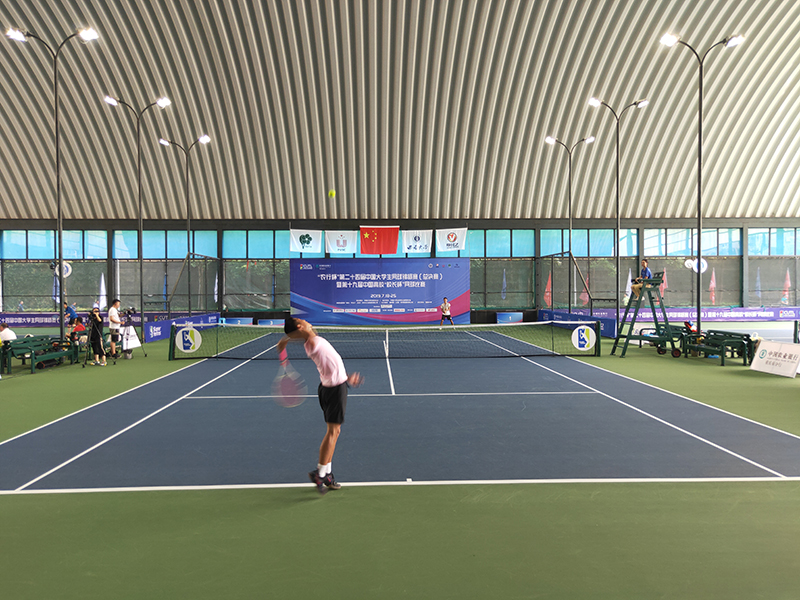
During serves and high lobs, players frequently look upward to follow the ball. Poorly positioned fixtures or unsuitable optical distribution can introduce glare into their field of view.
For this reason, tennis court lighting requires more than high-output lights. Designers need to consider fixture aiming angles, mounting positions, optical control and the typical viewing directions of players.
Precision optics and careful aiming can help direct light toward the court while limiting unwanted light and visual discomfort.
Broadcast Requirements: Consider the Camera as Well as the Player
For professional venues that host televised matches, lighting design may also need to address vertical illuminance, color rendering, flicker performance and the requirements of broadcast cameras.
These factors should be assessed against the relevant competition and broadcasting specifications. A court that looks bright in person does not necessarily meet every requirement for high-definition television coverage.
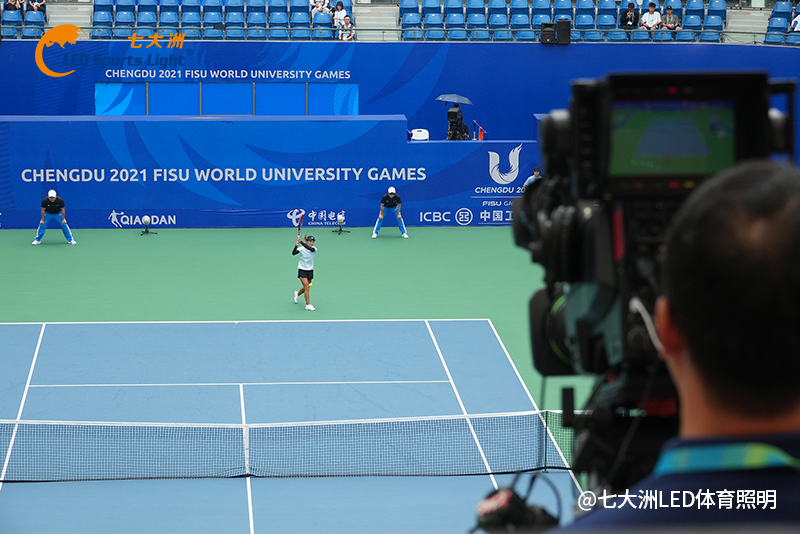
2. Why Different Tennis Venues Need Different Lighting Solutions
There is no single lighting layout that suits every tennis facility.
· Professional competition courts may require higher lighting performance, carefully controlled glare and additional consideration for spectators and television cameras.
· Outdoor tennis courts need appropriate coverage while limiting unwanted light spill into surrounding properties or nearby areas.
· Training and community courts may prioritize reliable everyday performance, manageable operating costs and practical maintenance.
· Multi-court tennis centers often need different lighting configurations for their main stadium, secondary courts and practice areas.
A reliable design begins with the actual venue conditions: court dimensions, mounting locations, surrounding buildings, intended use, environmental constraints and operational requirements.
For an existing facility, the first step should be to assess the current lighting system. The upgrade may involve new fixtures, revised aiming angles, a different optical distribution or improved lighting controls. The right approach depends on the problems identified during the assessment.
3. What Professional Tennis Venue Projects Can Teach Us
SCL Sports Lighting provides LED sports lighting systems and lighting design solutions for different sports facilities. Its tennis-related project experience illustrates why lighting design should be tailored to each venue rather than based on fixture wattage alone.
Case Study 1: Guangdong Olympic Tennis Center
The Guangdong Olympic Tennis Center has hosted major tennis events, including the WTA Guangzhou Open, and has also been associated with ITF Masters Tour MT400 competition.
According to SCL Sports Lighting published project information, the venue underwent an LED sports lighting refurbishment. The project included outdoor tennis courts and a lighting solution designed around the requirements of tennis play and professional competition.
The venue demonstrates an important principle: a professional tennis facility needs a lighting system that considers both the playing environment and the operational demands of the venue.
Uniform light distribution, controlled glare and appropriate fixture positioning are particularly important when players need to track high balls and move rapidly across the court. Where television broadcasting is required, the design must also be checked against the relevant broadcast specifications.
For tennis centers with multiple courts, different areas may require different lighting configurations rather than one identical setup throughout the facility.
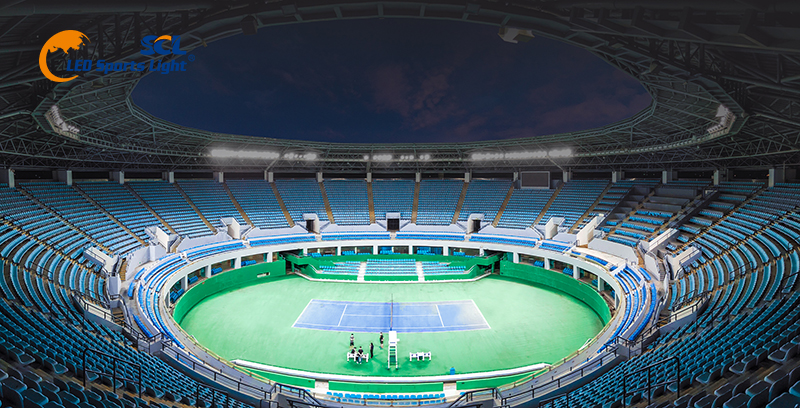
Case Study 2: Sichuan International Tennis Center
Sichuan International Tennis Center has served as a venue for tennis activities associated with the 31st FISU World University Games and the Chengdu Open, an ATP 250 tournament.
For facilities hosting high-level competitions, lighting needs to support consistent visibility across the playing area while taking account of athlete performance, spectator experience and, where applicable, broadcast requirements.
This type of venue highlights the value of integrated lighting design. Fixture selection, beam distribution, installation positions and control systems should work together to deliver the intended lighting performance.
The exact illuminance and uniformity targets should always be established from the applicable project specifications and verified through appropriate calculations and on-site measurements.
Case Study 3: Sanya International Tennis Center
Sanya International Tennis Center has hosted events associated with the ITF women’s tennis circuit and the China Tennis Tour CTA500.
For venues that accommodate both competitive events and regular court use, operational flexibility can be an important consideration.
Depending on the facility’s requirements, lighting controls may allow different operating modes for competitions, training and general use. This can help venue operators manage lighting according to actual needs instead of running every court at the same setting throughout the day.
The feasibility and benefits of dimming or zoning should be assessed against the lighting design, fixture compatibility and operational requirements of the venue.
Together, these projects illustrate why professional tennis lighting should be designed around the real conditions and intended use of each facility.
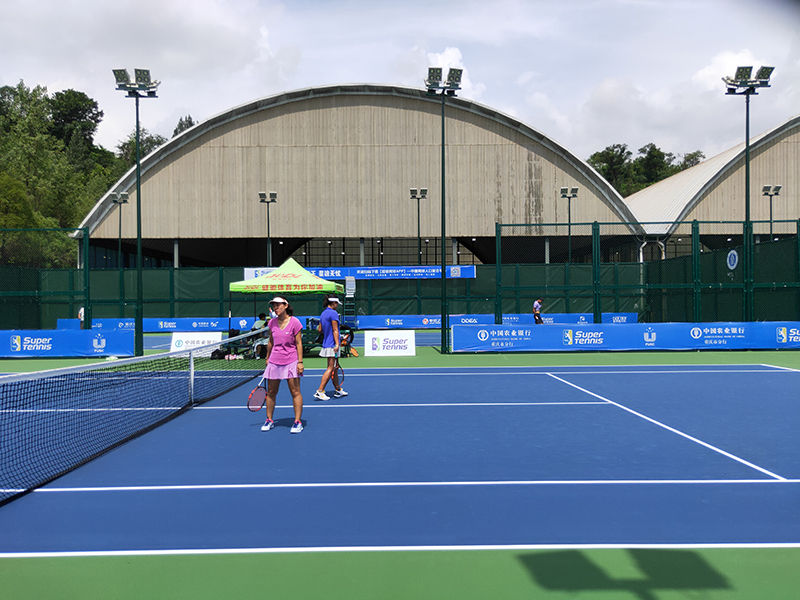
4. How to Evaluate the Long-Term Cost of LED Tennis Court Lighting
When comparing lighting suppliers, the lowest initial fixture price does not necessarily mean the lowest total cost.
A more useful approach is to consider the total cost of ownership over the expected service life of the system.
Key factors include:
· Initial investment: Fixtures, controls, wiring, installation and commissioning.
· Electricity consumption: Actual system power, operating hours, electricity tariffs and any effective dimming strategy.
· Maintenance: Fixture replacement, access equipment, labor and possible court downtime.
· Operating flexibility: Whether different lighting settings are available for competitions, training and recreational use.
· Reliability and support: Product quality, warranty terms, thermal management and after-sales service.
LED upgrades can reduce energy use and maintenance requirements compared with some traditional lighting systems. However, actual savings depend on the existing installation, the new system’s power consumption, operating schedules and control strategy. Savings should be calculated from project-specific data rather than assumed from the use of LED technology alone.
SCL Sports Lighting can assess fixture selection, optical distribution and control requirements according to the conditions of a specific tennis project. For an upgrade, a lighting simulation before installation and on-site measurements after commissioning can help verify whether the system meets the agreed performance targets.
5. Questions to Ask Before Choosing a Tennis Court Lighting Supplier
Before starting a new installation or upgrading an existing court, venue owners and project consultants should ask:
1. Does the proposal specify the target illuminance, uniformity and glare-control requirements?
2. Is a lighting simulation available for the actual court and mounting arrangement?
3. Is the optical distribution suitable for tennis, including high-ball visibility and unwanted light control?
4. If television broadcasting is required, does the design address the relevant broadcast criteria?
5. Can the solution be adapted to the main stadium, secondary courts and practice areas?
6. Are warranty coverage, maintenance arrangements and commissioning clearly defined?
7. Can key lighting performance indicators be verified through on-site measurements?
These questions help shift the decision from fixture specifications alone to the performance of the complete lighting system.
Conclusion: Design for Visibility, Not Just Brightness
Good tennis court lighting helps players follow the ball, move confidently and compete in a consistent visual environment. For venue operators, it should also provide practical maintenance, reliable operation and reasonable long-term costs.
Projects at venues such as Guangdong Olympic Tennis Center, Sichuan International Tennis Center and Sanya International Tennis Center demonstrate the variety of requirements that professional tennis facilities can present.
For anyone planning a new court or upgrading an existing facility, the best starting point is to define the intended use, applicable lighting requirements, site conditions and operational goals before choosing the fixtures.
SCL Sports Lighting combines LED sports lighting products with lighting design and application experience to develop solutions for tennis facilities with different requirements. The right system should always be selected and verified according to the needs of the specific venue.
https://www.stadiumlight.com/
GUANGDONG SEVEN CONTINENTS INDUSTRIAL CO., LTD -
AuthorPosts

- You must be logged in to reply to this topic.