

- This topic is empty.
-
AuthorPosts
-
2026-08-17 at 2:01 pm #10218
Introduction
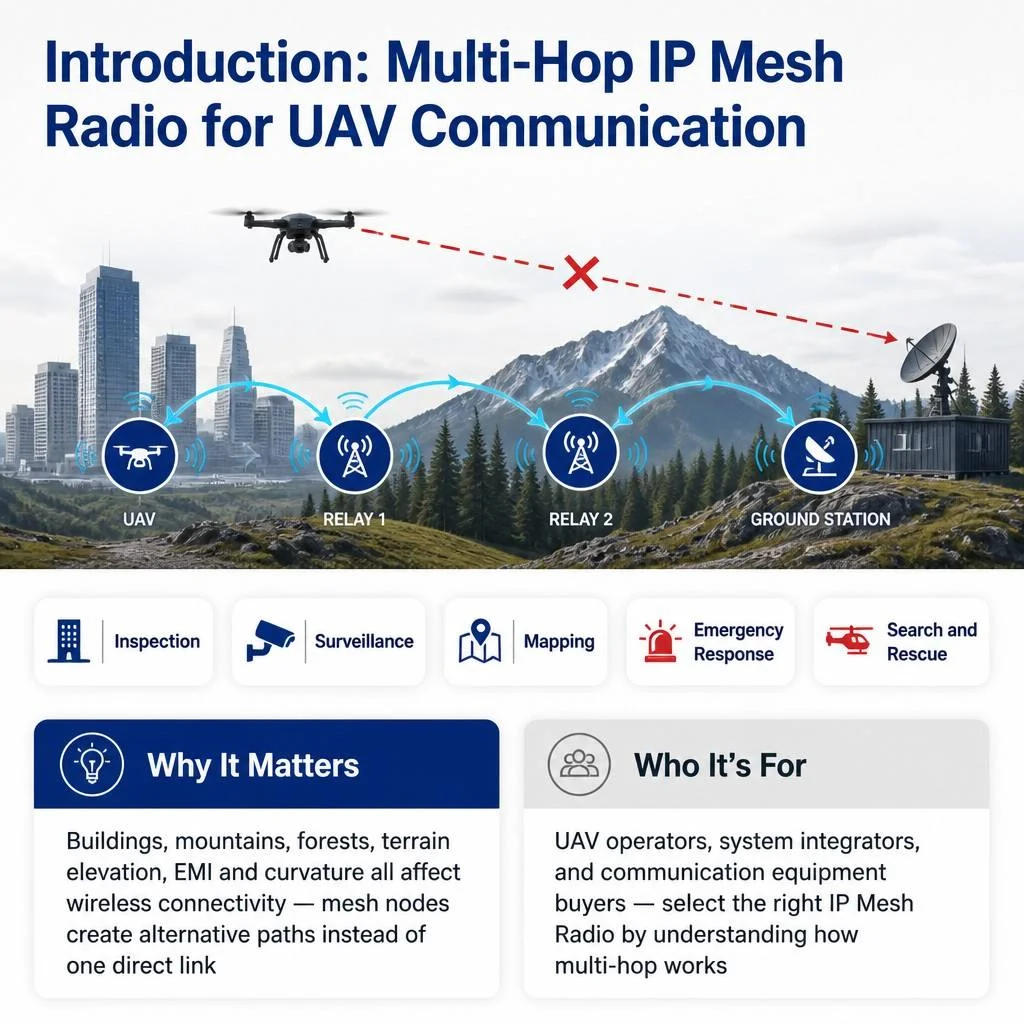
Unmanned aerial vehicles (UAVs) are increasingly used for inspection, surveillance, mapping, emergency response, agriculture, infrastructure monitoring, and search and rescue. As these applications become more demanding, the communication link between the UAV and ground operators has become just as important as the aircraft itself.
A drone may be able to fly several kilometers from its operator, but maintaining a stable communication link over that distance is not always straightforward. Buildings, mountains, forests, terrain elevation, electromagnetic interference, and the curvature of the operating environment can all affect wireless connectivity. For UAVs carrying cameras or other sensors, the challenge becomes even greater because the communication system may need to transmit high-quality video, telemetry, control commands, and other data simultaneously.
This is where multi-hop IP Mesh Radio technology becomes valuable. Instead of relying on a single direct wireless link between the UAV and a ground station, a mesh network can use multiple radio nodes to create alternative communication paths. Data can travel from one node to another until it reaches the intended destination. When designed correctly, this architecture can extend practical communication coverage while providing greater flexibility than a conventional point-to-point radio link.
For UAV operators, system integrators, and communication equipment buyers, understanding how multi-hop networking works is important when selecting an IP Mesh Radio for UAV communication. The objective is not simply to achieve the longest possible range on paper, but to build a communication network that remains stable as the UAV moves through different environments.
This article explains how multi-hop IP Mesh Radio extends UAV communication range, what factors influence actual performance, and how to design a reliable UAV communication network for demanding applications.
Why UAV Communication Range Is a Challenge
A UAV communication system must support connectivity between moving aerial platforms and other devices on the ground or in the air. The required communication range can vary considerably depending on the application.
A small commercial drone used for local inspection may only need a relatively short communication distance. By contrast, a UAV used for border surveillance, disaster assessment, pipeline inspection, or search and rescue may need to operate far beyond the immediate area of the operator.
Direct Radio Links Have Practical Limitations
In a conventional point-to-point architecture, the UAV communicates directly with a ground station or controller. As the distance increases, the wireless link can become less reliable.
Several factors can contribute to this problem:
-
Distance between communication nodes
-
Antenna height and orientation
-
Terrain obstruction
-
Buildings and other structures
-
Radio frequency interference
-
Transmitter power
-
Receiver sensitivity
-
Data rate requirements
A direct link may work well under ideal line-of-sight conditions but become unstable when the UAV flies behind an obstruction or enters an area with poor radio propagation.
For this reason, the advertised maximum range of an individual radio should not automatically be treated as the practical coverage of an entire UAV mission.
How Multi-Hop IP Mesh Radio Works
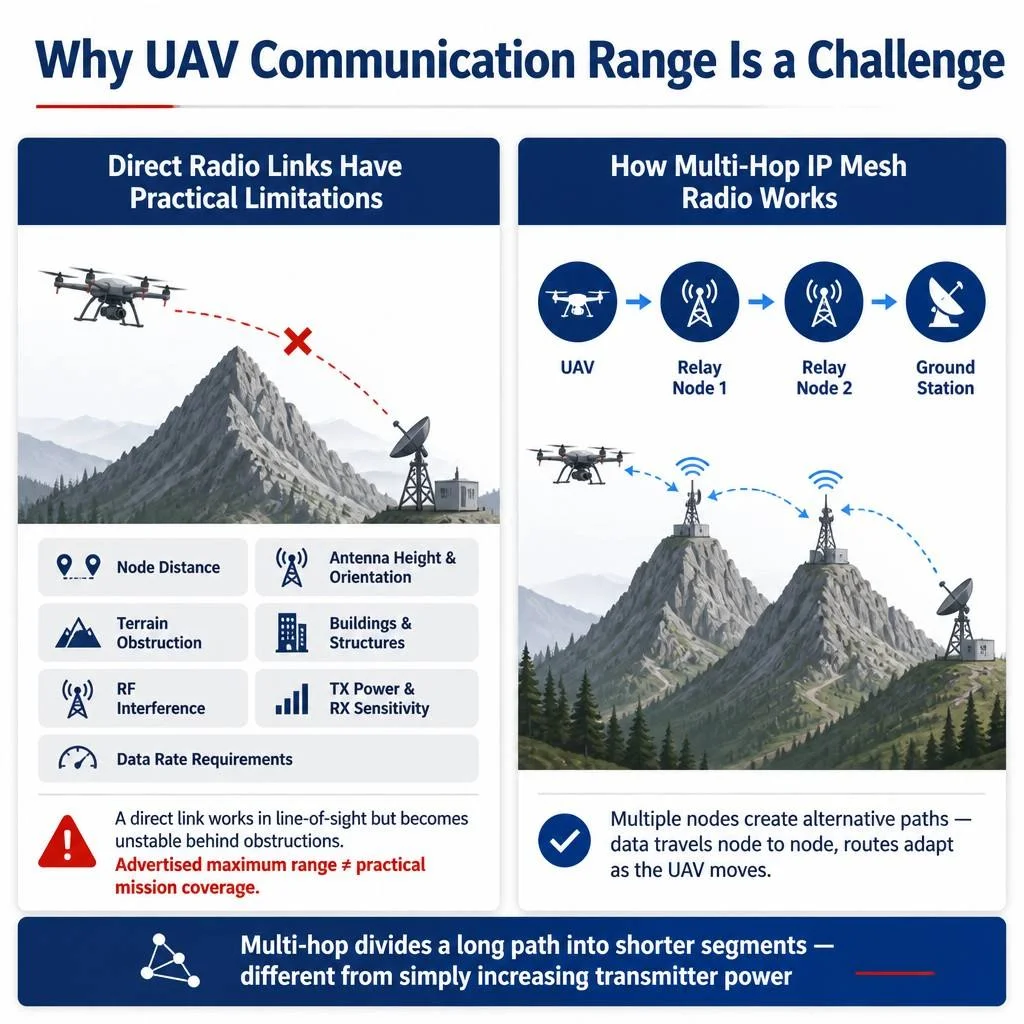
The basic concept behind multi-hop networking is relatively simple. Instead of requiring every device to communicate directly with the final destination, intermediate nodes can forward traffic through the network.
Imagine a UAV that is too far away to maintain a reliable direct connection with a command vehicle. A second radio node positioned between the UAV and command vehicle can receive the data and forward it to another node. The communication path effectively becomes a sequence of shorter wireless links.
A simplified network might include:
UAV → Relay Node 1 → Relay Node 2 → Ground Station
Each node forms part of the overall mesh network.
Multiple Nodes Create More Communication Paths
An IP Mesh Radio network can include several nodes distributed across the operating area. Depending on the network architecture, these nodes can communicate with neighboring devices and establish routing paths dynamically.
This means the network is not necessarily dependent on one fixed connection.
If the UAV changes position, the most suitable communication route can change as well.
Multi-Hop Is Different From Simply Increasing Transmitter Power
One common misconception is that longer range always requires higher radio power. Increasing transmitter power can help in some situations, but it does not solve every coverage problem.
A high-power radio still needs a usable propagation path. If a mountain or large building blocks the signal, simply increasing power may not provide the desired result.
Multi-hop IP Mesh Radio communication takes a different approach: it divides a long communication path into multiple wireless segments.
This can make it easier to maintain connectivity across complicated environments.
How Multi-Hop IP Mesh Radio Extends UAV Communication Range
The main advantage of a multi-hop architecture is that it allows communication coverage to be extended beyond the practical range of a single radio link.
Extending Coverage Through Relay Nodes
Relay nodes act as communication bridges between distant parts of the network.
For example, suppose a UAV needs to communicate with a command center located beyond the reliable range of the onboard radio. A relay node can be installed on a vehicle, building, elevated structure, or another UAV.
The relay receives the UAV's data and forwards it toward the command center.
This approach can extend the effective network coverage without requiring every node to have a direct connection to the central station.
Maintaining Connectivity in Difficult Terrain
Terrain is one of the biggest challenges for long-range UAV communication.
Mountains, hills, forests, and urban structures can interrupt direct line-of-sight paths.
A carefully positioned long range IP Mesh Radio relay can help route communication around these obstacles.
For example, in mountainous search and rescue operations, ground teams may be positioned on different slopes. A UAV flying above the area can communicate with nearby relay nodes, while those nodes maintain links with the command center.
This creates a communication network that is more flexible than a single direct radio link.
The Role of UAVs as Mesh Nodes
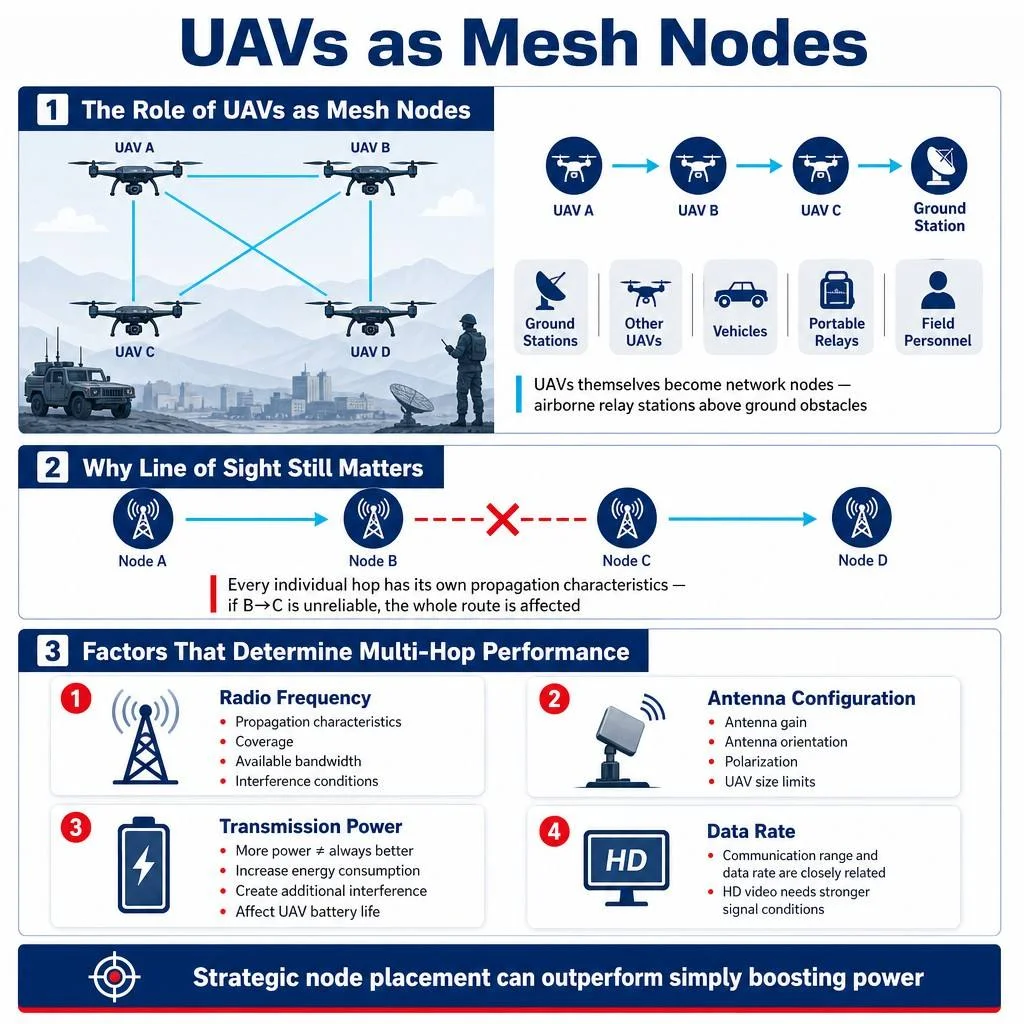
One of the most interesting aspects of IP Mesh Radio technology is that UAVs themselves can become network nodes.
A UAV equipped with an IP Mesh Radio can potentially communicate with:
-
Ground stations
-
Other UAVs
-
Vehicles
-
Portable relay units
-
Field personnel
This makes it possible to create airborne communication networks.
UAV-to-UAV Communication
Multiple UAVs can form a mesh network in which one aircraft helps relay data from another.
For example:
UAV A → UAV B → UAV C → Ground Station
If UAV A is outside the direct communication range of the ground station, UAV B may serve as an intermediate node.
This approach can be useful for large-area surveillance and missions where UAVs need to operate at different distances from the command center.
Airborne Relay Applications
A UAV positioned at a suitable altitude can serve as an airborne relay station.
Because the relay is above many ground-level obstacles, it may establish communication paths that are difficult to achieve with ground-based equipment.
This is particularly useful for:
-
Disaster response
-
Wildfire monitoring
-
Border surveillance
-
Search and rescue
-
Large infrastructure inspection
An IP Mesh Radio for UAV applications therefore has the potential to provide both direct communication and network extension capabilities.
Why Line of Sight Still Matters
Although multi-hop networking can significantly improve coverage, it does not eliminate the importance of radio propagation conditions.
A common mistake is to assume that a mesh network can communicate through any obstacle simply because multiple nodes are available.
In reality, every individual wireless hop still has its own propagation characteristics.
Each Hop Needs a Reliable Wireless Link
Consider a network consisting of four nodes:
Node A → Node B → Node C → Node D
Even if the total distance between A and D is very large, the network can work effectively if each individual hop has a stable connection.
However, if the link between B and C becomes unreliable, the entire communication route may be affected unless an alternative path is available.
This is why relay placement and network planning are essential when deploying an IP Mesh Radio communication system.
Factors That Determine Multi-Hop UAV Communication Performance
Multi-hop networking can extend communication coverage, but actual performance depends on several technical and environmental factors.
Radio Frequency
Frequency selection affects:
-
Propagation characteristics
-
Coverage
-
Obstacle penetration
-
Available bandwidth
-
Interference conditions
Lower frequencies may provide stronger coverage over certain environments, while higher frequencies can provide greater bandwidth for data-intensive applications.
For UAV applications involving high-definition video, the frequency must provide enough throughput without sacrificing the required communication stability.
Antenna Configuration
Antenna selection can have a major impact on communication performance.
Important considerations include:
-
Antenna gain
-
Antenna orientation
-
Polarization
-
Installation position
-
UAV size and weight limitations
An antenna that performs well on a ground vehicle may not necessarily be the best option for a small UAV.
Transmission Power
Transmission power affects how far a radio signal can travel, but higher power is not always the best solution.
Increasing power may:
-
Increase energy consumption
-
Create additional interference
-
Affect UAV battery life
-
Increase thermal requirements
A well-designed multi-hop network can sometimes achieve better overall coverage through strategic node placement rather than simply increasing power.
Data Rate
Communication range and data rate are often closely related.
High data rates typically require stronger signal conditions. If an operator expects stable HD video at long distances, the network must be designed to provide sufficient signal quality and bandwidth.
This is particularly important when choosing an IP Mesh Radio for drone video transmission.
Multi-Hop IP Mesh Radio for Real-Time Video Transmission
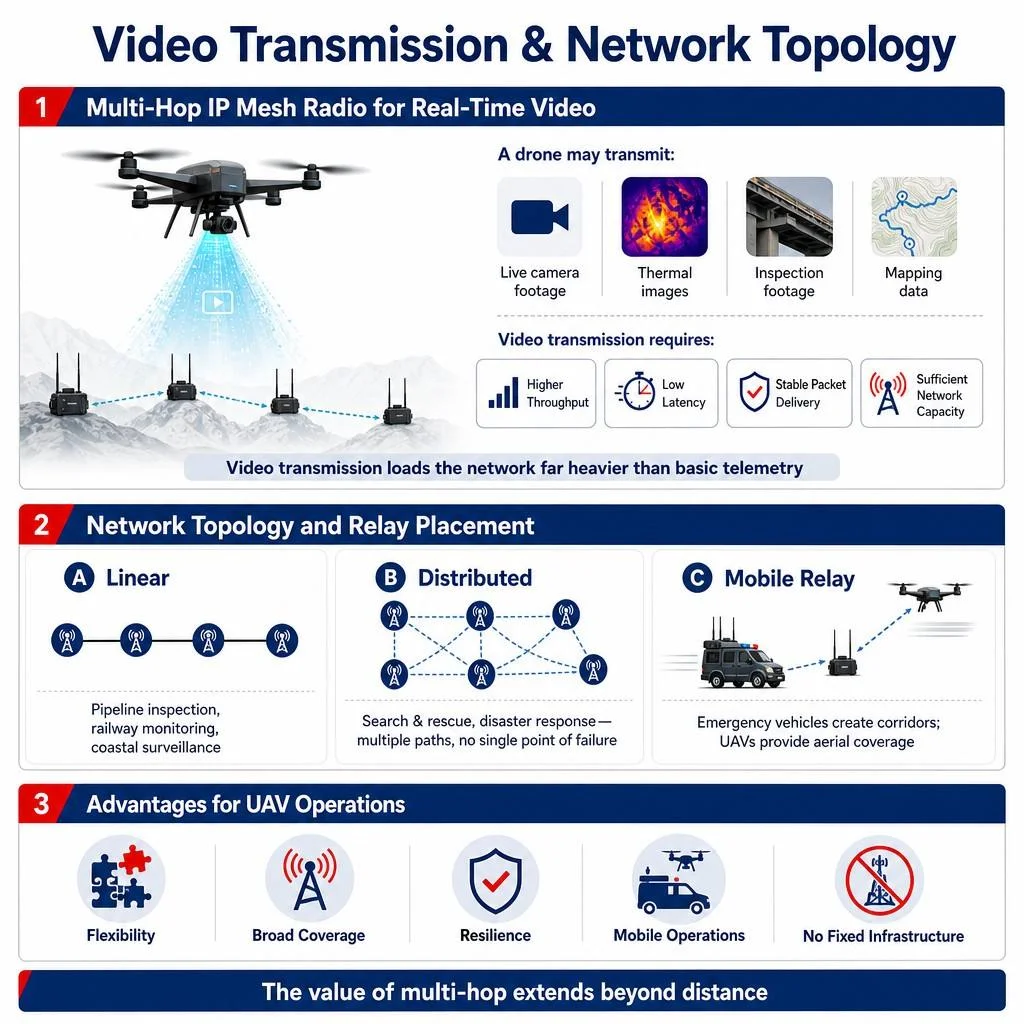
UAV video has become an important part of modern aerial operations.
A drone may transmit:
-
Live camera footage
-
Thermal images
-
Inspection video
-
Mapping data
-
Situational awareness information
However, video transmission can place a much heavier load on a wireless network than basic telemetry.
Balancing Range and Video Quality
A communication system designed only for telemetry may prioritize long range and low data consumption.
A video transmission system has different priorities:
-
Higher throughput
-
Low latency
-
Stable packet delivery
-
Sufficient network capacity
When multiple hops are involved, network designers must also consider the additional traffic created by forwarding data between nodes.
This means choosing an IP Mesh Radio for high bandwidth applications requires more than checking the maximum transmission distance.
Network Topology and Relay Placement
The physical arrangement of mesh nodes can strongly influence communication performance.
Linear Deployment
A linear topology may be suitable for applications such as:
-
Pipeline inspection
-
Railway monitoring
-
Long road corridors
-
Coastal surveillance
Nodes can be placed at strategic intervals along the operating route.
Distributed Deployment
For search and rescue or disaster response, nodes may need to be distributed across a wider area.
A distributed mesh network can provide multiple communication paths and reduce dependence on a single relay.
Mobile Relay Deployment
Vehicles or UAVs can also carry IP Mesh Radio nodes.
This allows the network to move with the operation.
For example, emergency vehicles can establish a temporary communication corridor while a UAV provides aerial coverage.
Conclusion
Multi-hop networking provides an effective way to extend UAV communication beyond the practical limitations of a single direct radio link. By allowing data to travel through relay nodes, IP Mesh Radio systems can create larger and more flexible communication networks for aerial operations.
The key advantage is not simply greater distance. A well-designed multi-hop network can also provide flexible coverage, alternative communication paths, mobile connectivity, and support for voice, telemetry, video, and other IP-based data.
For UAV applications such as search and rescue, disaster response, industrial inspection, surveillance, and mapping, these capabilities can make communication more reliable and operationally useful.
However, successful deployment requires careful attention to frequency selection, antenna configuration, bandwidth, relay placement, terrain, network topology, and actual field conditions. Buyers should therefore evaluate an IP Mesh Radio communication system based on the complete mission requirement rather than focusing on a single specification such as maximum range.
When properly designed and deployed, a multi-hop long range IP Mesh Radio network can provide UAV operators with a scalable communication foundation that adapts to changing environments and supports increasingly data-intensive aerial applications.
http://www.suntor.com
suntor -
-
AuthorPosts

- You must be logged in to reply to this topic.