

- This topic is empty.
-
AuthorPosts
-
2026-10-08 at 10:33 am #10707
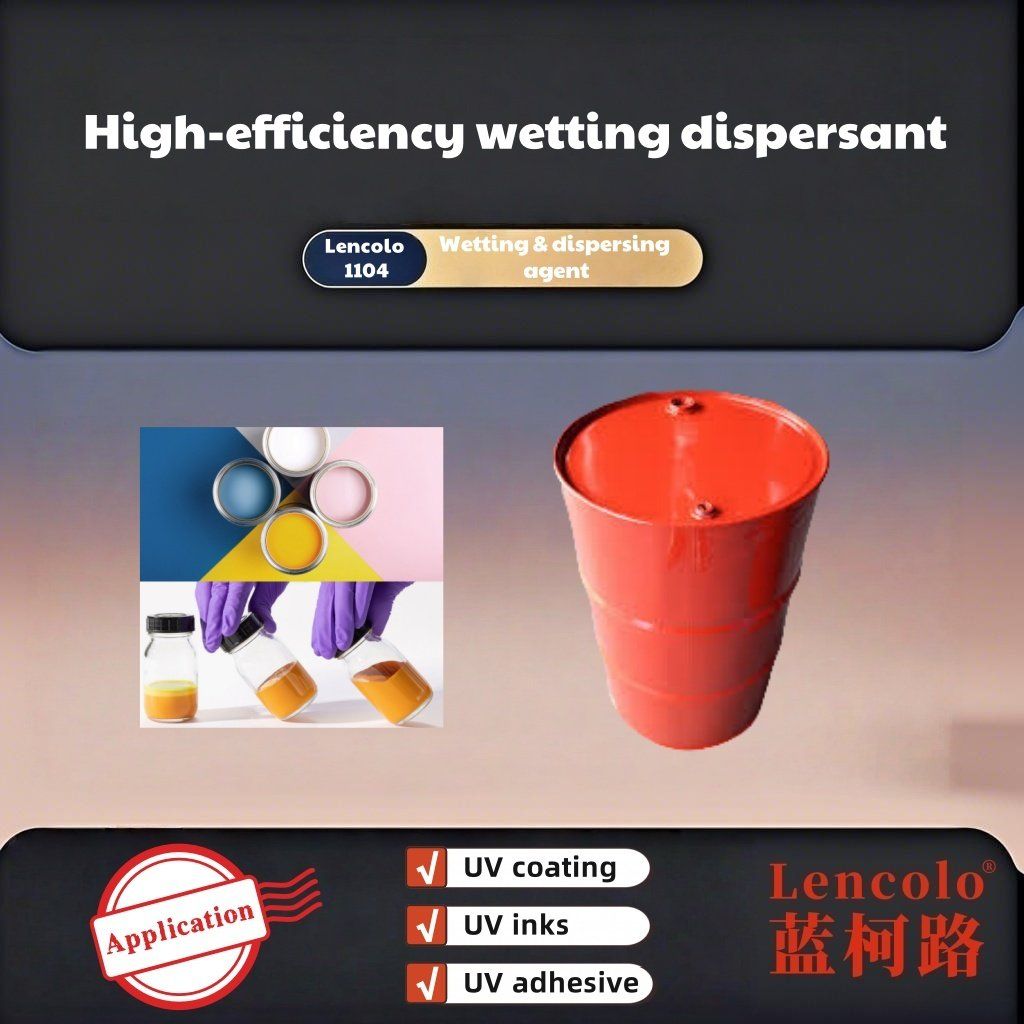
Q: Why is wetting-agent selection important in UV coatings?
A wetting agent helps the liquid resin phase spread over solid particles such as pigments, matte powders, and fillers. Good wetting promotes more uniform particle incorporation and can reduce problems such as agglomeration, uneven matteness, unstable gloss, and inconsistent surface appearance.
In UV coatings, this becomes particularly important because the system cures quickly. Once the coating starts curing, there is less time for poorly wetted particles to redistribute. A dispersion problem that looks minor during mixing can therefore become a visible surface defect after curing.
Q: Should the wetting agent be selected according to the type of solid material?
Yes. This is one of the most important selection criteria.
Matte powders, pigments, and functional fillers do not have identical surface characteristics. An additive that works well for one type of pigment may not provide the same wetting effect with a matting agent.
For matte UV coating systems, Lencolo 1108/1109 are wetting dispersants positioned specifically for matte powder, with good wettability of matte powder. They can be considered when a formulation requires more uniform incorporation of matting agents and consistent matte appearance.
The appropriate addition level still needs to be confirmed through actual formulation testing.
Q: Can a wetting agent improve the final matte appearance?
It can contribute, but wetting alone does not determine the final matte level.
If matte powder is poorly wetted, particles may distribute unevenly and create variations in surface roughness, gloss, or matteness. Improving wetting can help create a more uniform particle distribution.
However, the final result also depends on resin chemistry, powder type and loading, film thickness, application method, curing conditions, and leveling. Therefore, a wetting agent should be evaluated by looking at the cured coating rather than only the dispersion stage.
Q: How does the UV resin affect wetting-agent selection?
The resin is an important part of the compatibility equation. A wetting agent needs to function effectively within the specific resin system without causing problems such as poor clarity, surface defects, reduced adhesion, or unstable viscosity.
For this reason, it is better to test the additive in the actual UV resin formulation. The interaction among UV resin, matte powder, wetting dispersant, photoinitiator, and other additives can determine whether the final coating remains stable during storage and curing.
Q: Do wetting agents and leveling agents solve the same problem?
No. They are related, but their functions are different.
A wetting agent primarily helps the liquid phase interact with and distribute solid particles. A leveling agent mainly improves the flow and surface uniformity of the applied coating.
For example, Lencolo 3002 is positioned as a fast leveling agent with recoatability, while Lencolo 3160 is a versatile re-coatable leveling agent for water-based and oil-based systems, including applications involving hot stamping and recoating.
A matte UV coating can therefore have good powder wetting but still show poor leveling. Both aspects may need separate optimization.
Q: Can foam become a problem when improving wetting and dispersion?
Yes. High-speed mixing and dispersion can introduce air into the formulation, and excessive foam may lead to processing difficulties or surface defects.
For UV systems, Lencolo 2108 is a high-efficiency UV defoamer with good compatibility, while Lencolo 2190 is a silicone defoamer with strong defoaming ability. These additives can be evaluated when foam control becomes necessary.
The objective is not simply maximum defoaming, but sufficient foam control without negatively affecting wetting, l
https://www.lencolo37.com/
Guangdong Lencolo New Material Co., Ltd. -
AuthorPosts

- You must be logged in to reply to this topic.