

- This topic is empty.
-
AuthorPosts
-
2026-06-22 at 2:01 pm #9659
Food safety inspection technology has become a core part of modern food manufacturing. As global regulations tighten and consumer expectations rise, manufacturers are increasingly relying on advanced detection systems to prevent contamination before products reach the market.
Two of the most widely used technologies in this field are food metal detectors and X-ray inspection machines. Although they are often used in similar production environments and sometimes even on the same production line, they are fundamentally different in how they work, what they detect, and where they are most effective.
Understanding the difference between these two systems is essential for choosing the right solution for your production needs.
1. Basic Definition of Each Technology
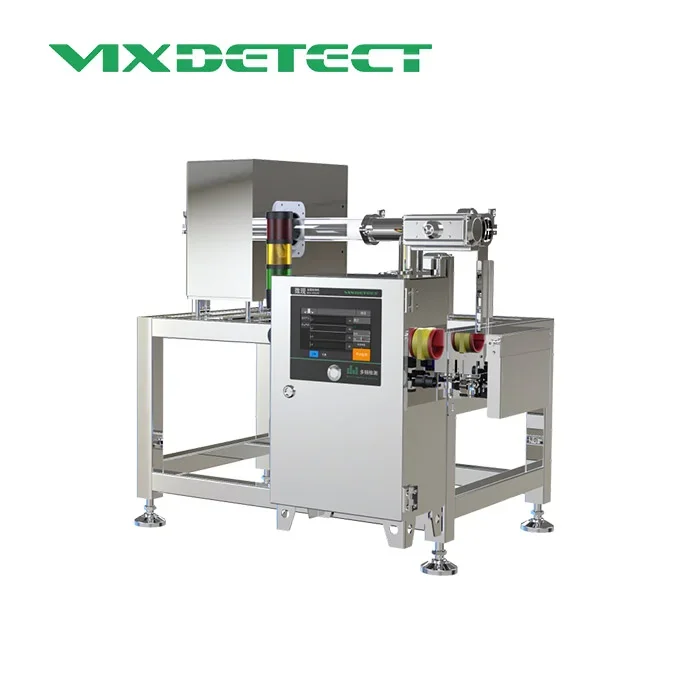
1.1 What Is a Food Metal Detector?
A food metal detector is an inspection device designed specifically to detect metallic contaminants in food products. It uses electromagnetic fields to identify the presence of metal particles.
When a metal object passes through the detection coil, it disturbs the electromagnetic field, triggering an alarm or rejection system.
Food metal detectors are widely used in:
-
Bakery production
-
Meat and poultry processing
-
Snack manufacturing
-
Dairy processing
-
Packaged dry foods
Their primary function is simple: detect metal contamination and remove affected products from the production line.
1.2 What Is an X-ray Inspection Machine?
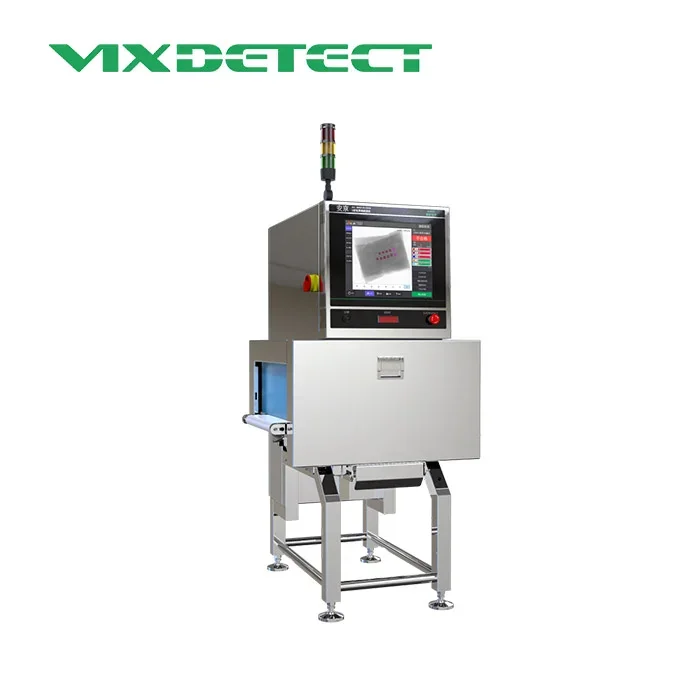
An X-ray food inspection system uses low-energy X-ray radiation to scan products and create images of their internal structure. Different materials absorb X-rays at different levels, allowing the system to detect foreign objects based on density differences.
Unlike metal detectors, X-ray systems are not limited to metal detection.
They are commonly used in:
-
Ready meals
-
Bottled and canned foods
-
Frozen foods
-
High-value packaged products
-
Complex or multi-layer packaging environments
X-ray systems provide a more comprehensive inspection capability, offering both contamination detection and quality control.
2. Core Working Principle Differences
2.1 How Food Metal Detectors Work
Food metal detectors operate using electromagnetic induction.
The system creates an electromagnetic field through detection coils. When metal enters this field, it disrupts the balance of the signal. The system then identifies:
-
Ferrous metals (iron-based)
-
Non-ferrous metals (aluminum, copper)
-
Stainless steel (more difficult to detect)
The key limitation is that the system can only detect metallic materials.
2.2 How X-ray Machines Work
X-ray inspection systems work based on density differences.
When products pass through the X-ray beam:
-
Dense materials absorb more X-rays
-
Less dense materials absorb fewer X-rays
A digital sensor captures this variation and generates an image. The system can detect:
-
Metal
-
Glass
-
Stone
-
Bone
-
Dense plastic
-
Rubber compounds
This makes X-ray systems significantly more versatile than metal detectors.
3. What They Can Detect (Key Difference)
3.1 Food Metal Detector Detection Capabilities
A food metal detector can detect:
-
Iron
-
Steel
-
Aluminum
-
Copper
-
Stainless steel (depending on sensitivity level)
However, it cannot detect non-metal contaminants, such as:
-
Glass
-
Stone
-
Bone
-
Plastic
-
Wood
3.2 X-ray Machine Detection Capabilities
An X-ray system can detect a much wider range of contaminants, including:
-
All metals
-
Glass fragments
-
Ceramic pieces
-
Stones
-
Bones (in meat products)
-
Hard plastics
-
Dense rubber
This makes X-ray technology more suitable for complex food safety requirements.
4. Packaging Compatibility Differences
4.1 Metal Detectors and Packaging Limitations
Food metal detectors are highly sensitive to electromagnetic interference, which means packaging type matters.
They struggle with:
-
Aluminum foil packaging
-
Metallized film packaging
-
Highly moist or salty products
-
Conductive packaging materials
Special settings or “metal-free zones” may be required for accurate detection.
4.2 X-ray Machines and Packaging Flexibility
X-ray systems are far more flexible and can inspect:
-
Foil packaging
-
Metal cans
-
Glass bottles
-
Multi-layer packaging
-
Sealed cartons
Because they rely on density imaging rather than electromagnetic fields, packaging materials have less impact on performance.
5. Sensitivity and Accuracy Comparison
5.1 Metal Detector Sensitivity
Food metal detectors are extremely sensitive to small metal particles. In ideal conditions, they can detect:
-
As small as 0.3 mm to 1.5 mm metal fragments
However, sensitivity is affected by:
-
Product moisture
-
Temperature
-
Salt content
-
Packaging type
5.2 X-ray Machine Sensitivity
X-ray systems also offer high sensitivity but depend on:
-
Product thickness
-
Density variation
-
Imaging resolution
They are particularly effective in detecting irregular shapes and dense contaminants inside complex products.
6. Cost Difference Between the Two Systems
6.1 Food Metal Detectors: Lower Cost Option
Food metal detectors are generally:
-
More affordable
-
Easier to install
-
Lower maintenance cost
-
Faster ROI for basic applications
They are often the first choice for small and medium-sized food manufacturers.
6.2 X-ray Machines: Higher Investment
X-ray systems are significantly more expensive due to:
-
Advanced imaging technology
-
Radiation shielding systems
-
Complex software algorithms
-
Higher maintenance requirements
However, they provide broader inspection capabilities and better long-term flexibility.
7. Safety and Regulatory Considerations
7.1 Metal Detectors and Food Safety Standards
Food metal detectors are widely used to meet:
-
HACCP requirements
-
BRC standards
-
FDA compliance guidelines
-
ISO 22000 food safety systems
They are a fundamental requirement in many food safety programs.
7.2 X-ray Systems and Safety Compliance
X-ray machines must comply with:
-
Radiation safety regulations
-
Shielding certification requirements
-
International food inspection standards
Despite using radiation, modern food X-ray systems are designed to be extremely safe and operate within strict regulatory limits.
8. Maintenance and Operation Differences
8.1 Metal Detector Maintenance
Food metal detectors require:
-
Regular calibration
-
Coil cleaning
-
Sensitivity checks
-
Basic preventive maintenance
They are relatively simple to operate and maintain.
8.2 X-ray System Maintenance
X-ray machines require more advanced maintenance, including:
-
Sensor calibration
-
Radiation system checks
-
Software updates
-
Cooling system maintenance
-
Shielding inspection
They often require trained technicians for servicing.
9. Speed and Production Line Integration
9.1 Metal Detectors in Production Lines
Metal detectors are:
-
Extremely fast
-
Suitable for high-speed conveyor systems
-
Easy to integrate
-
Ideal for bulk production environments
They are commonly installed early or mid-line in production.
9.2 X-ray Machines in Production Lines
X-ray systems are slightly slower but offer:
-
Final-stage inspection capability
-
Detailed product analysis
-
Quality control (shape, missing items, breakage detection)
They are often placed at the end of production lines.
10. When to Choose Metal Detectors vs X-ray Systems
Choose a Food Metal Detector if:
-
You only need metal detection
-
Budget is limited
-
Product is simple (dry or unpackaged)
-
High-speed production is required
-
You want a cost-effective solution
Choose an X-ray Machine if:
-
You need to detect non-metal contaminants
-
You use complex or multi-layer packaging
-
You require high-end quality control
-
You produce premium food products
-
Regulatory requirements are strict
11. Can They Be Used Together?
Yes. In fact, many modern food factories use both systems:
-
Metal detectors for primary, high-speed screening
-
X-ray machines for final inspection and quality assurance
This combination provides the highest level of food safety protection.
12. Future Trends in Food Inspection Technology
The future of food inspection is moving toward:
-
AI-powered defect recognition
-
Integrated X-ray + metal detection systems
-
Real-time data monitoring
-
Smart factory connectivity (IoT)
-
Self-calibrating inspection systems
These advancements are making both technologies more accurate, automated, and efficient.
Conclusion
The main difference between food metal detectors and X-ray machines lies in their detection capability and technology principle.
-
Metal detectors are specialized, fast, and cost-effective—but limited to detecting metals only.
-
X-ray machines are more advanced, versatile, and powerful—but come with higher cost and complexity.
Neither system is universally “better.” Instead, the best choice depends on product type, packaging, regulatory requirements, and production goals.
For many food manufacturers, combining both technologies provides the strongest and most reliable food safety solution.
http://www.vixdetect.net
vixdetect -
-
AuthorPosts

- You must be logged in to reply to this topic.